WALK IN THE RAIN
Matěj Krajíček
Artist
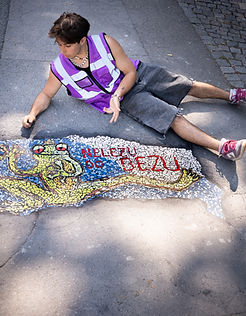
Matěj Krajíček (born 2003), also known by his artist name Krajdos, is from Pardubice and currently studies multimedia at the Faculty of Fine Arts at the University of Ostrava. His work primarily focuses on multimedia and street art. His work is closely connected to the streets and street culture. It all started in high school with skateboarding and making his own longboards under his brand, Foshna. Later, he switched from an IT high school to an art path. He started painting murals, and for the last two years, he has been working on a "mosaic street invasion." This project originally began as part of his bachelor's degree. Through his mosaics, Matěj shows his belief that street art can actually fix and improve public spaces. Even though his work is sometimes on the edge of what is legal, he decided to be completely open about it and do what he feels is right. He likes to start conversations about public space and our responsibility for it. But most of all, he values the process itself—the moments when he can sit on the street and play with "colored stones" alongside his friends and his girlfriend, Simona Hochmalová. Traveling is a major source of inspiration for him. In recent years, he completed a three-month internship in Berlin, studied for a semester in Porto, and recently returned from another exchange program in Seoul, South Korea.
Street art repairs the cities.
What's up? My name is Matěj Krejček. I'm creating under the nickname Kreidos. I'm from Pardubice. It's my hometown, but I'm studying in Ostrava, at the Faculty of Fine Arts, under Jiří Suruvka.
I study multimedia, so it's basically everything. It can be paintings, drawings, video, photography, whatever—basically everything. And yeah, but I'm mostly doing street art, so that's probably the reason why we are here today.
And in the last two years, I started to work with mosaics. It was part of my bachelor's thesis, and since I started, I didn't stop.
Before mosaics, there were a lot of months of thinking because it was part of my bachelor's degree, so I should write many pages about that. So I slowly started creating, like, a concept about that.
I started basically to ask myself, like: What is street art? What is the role of street art in cities? What is street art for me?
And basically, I found the answer that street art repairs the cities.
In my project, I tried to do that, like, really. Like, I really tried to repair it. That was, like, what I was thinking when I started. And the first steps were next to the Faculty of Fine Arts in Ostrava, and it was a lot of weeks of trying and experimenting with the materials, with the glue, with the tiles, and, yeah, basically materials of all the types. The first one was on Masarykovo náměstí, Masaryk Square. It's basically the center of the center of Ostrava, the city where I study. It was funny because there are lots of people walking every day, and the place is in front of a police station. So, like I said, my goal is to repair the cities, and my work is only about this. I believe I'm doing that. But that day, it was, like, a first experiment when I took this idea to the public. So, in the morning, I walked there, and there were, like, 20 policemen because it was, like, 6 a.m. They saw me. Nobody cared. Then we started. They were walking around us, like, every 20 minutes because, like I said, it's the center of the center. Basically, they told me only, like, "Oh, that's a good idea. Finally, someone did that." And for me, it was, like, a first impression, like, "Oh, that's the right way. I should continue in this." And yeah, I finished my bachelor's, and I went for summer holidays back home to Pardubice, and I did one mosaic here in Kostelní Street. And one politician, she shared the mosaics, like, "Oh, what a nice mosaic in our city." And yeah, the snowball of media and televisions and interviews started, and since that time, we never stopped. It's kind of like potholes, and the places I'm repairing, it's kind of like a scar for the street because usually, usually there's some reason why it's there, and nobody cares about that. So that's also the reason why I choose to focus on these places. For me, it's also really important to know the places because it's not like I see the hole in the ground and I'm like, "Oh, let's do a mosaic there." It's usually like I'm doing big research before. I'm also trying to watch people, how they are acting there, and I'm asking a question before. And after that, I'm coming with some concept or, like, with the design I'm going to show there. I like the idea that streets belong to everybody, and so also the mosaics, what we are doing there, it's not only my work. I love to speak with the people on the streets, and I really love when they are joining me. It's not like my artwork, but it's like community artwork. And I'm meeting a lot of people. There are so many different stories. I'm always like, "Oh, you should join us, come here," and people are curious about it. Yeah, they recognize us, so they are coming like, "Oh, I saw you, and I would like to join you." And so, yeah, this is, like, for me really important, and I have a lot of stories, and I met a lot of people. So every time when I'm walking, like, when I see my mosaics, like, after time, I remember all these stories. And I'm really glad that even if it's maybe one year, people are still sharing the mosaics on social media and tagging me there, and I can see that there is still life around the mosaics. It's street art, and like I said, it's connected to time. So yeah, my goal is, like, to do the best work I can, but some of it's also, like, kind of an experiment with the materials because every street is acting differently. Like, the materials are different during the summer, during the winter. So yeah, it's still, like, working. So yeah, I'm also, like, curious how long the mosaics are going to be there, and it's also, like, kind of fun to watch this experiment.